
The Indian rupee fell to a record low against the US dollar due to rising crude oil prices, foreign institutional investor selling, and weak domestic equity market sentiment.
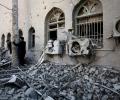
The logic of war plus the gathering storms in US politics as the midterms loom large leave him with no real alternative but to negotiate, points out Ambassador M K Bhadrakumar.

'If movement remains stalled for three to four months, more than 300,000 recruitments from India could be affected.'

In response to Prime Minister Narendra Modi's call for austerity, political leaders are reducing convoys and promoting public transport to conserve fuel.

Delhi should keep all its options open in what is essentially a transitional period in the geopolitics of energy rather than remain a gatekeeper serving Trump's 'America First', suggests Ambasssador M K Bhadrakumar.

Qatar has halted liquefied natural gas (LNG) production after its facilities came under attack amid the ongoing West Asia conflict, disrupting supplies to India and squeezing feedstock availability for key domestic sectors.

The United States' historical strategic alignment with Pakistan, dating back to the Cold War, has consistently aimed to create a political and military parity with India, despite India's significantly larger size and resources. This long-standing relationship continues to influence regional dynamics, particularly in West Asia and the Indo-Pacific.

Sensex and Nifty post steepest weekly loss in over a year, falling nearly 3 per cent.

The Indian government has increased measures to secure fuel and gas supplies following the Strait of Hormuz closure, urging citizens to avoid panic buying. Refineries are operating at high capacity, and sufficient stocks of petrol and diesel are available nationwide.

'Even if the war ends tomorrow, which is unlikely, and we go back to the pre-war status quo, the world will still need some time to get over the sudden shock of oil price increases.'

Indians returning from the Middle East share their experiences of fear and uncertainty as the conflict between the US, Israel, and Iran disrupts travel and daily life, leaving many stranded and facing financial strain.

At least eight civilians have been reported killed, and 95 others have sustained injuries following United States-Israeli strikes, Iranian state media Press TV reported.

Economist Jeffrey Sachs saw Gulf nations' decision to partner with the US through the Abraham Accords as an "invitation for disaster" as it made them more dependent on American protection.

The International Chess Federation (FIDE) has sought to allay security concerns surrounding the upcoming Candidates Tournament in Cyprus, emphasising that safety measures and contingency plans are in place despite regional instability.

The big question is whether Trump is any longer in command of the situation. For all practical purposes, the war seems set to cascade as the US is preparing for a potential ground operation in Iran and threatens to destroy 'bridges next, then electric power plants', points out Ambassador M K Bhadrakumar.

Voters in Kerala, Assam, and Puducherry are voting in crucial assembly elections.

Karex, the Malaysian company that makes roughly one in five of the world's condoms -- about five billion a year, supplying Durex and Trojan among others -- announced this week that it is raising prices by up to 30 percent. The reason is the Strait of Hormuz.

The Lok Sabha witnessed a heated debate between BJP and Congress members regarding the handling of Naxalism, with the BJP accusing the previous UPA government of failing to contain left-wing extremism and the Congress defending its efforts to curb the threat.

India-based Iranian actresses Mandana Karimi and Elnaz Norouzi share their deep concerns and anxieties about the escalating crisis in Iran, and reveal the personal toll on their lives and the Iranian diaspora.

The benchmark BSE Sensex's trailing 12-month price-to-earnings (P/E) multiple has declined to 20.2x, its lowest since May 2020, driven by a record $42 billion FPI selloff since September 2024 and concerns over corporate earnings and economic growth.

'We are getting used to the constant alerts to take shelter, listening to sonic booms from jets flying above us, hearing news of neighbouring ports being targeted, and being the only ship in the terminal.'

"It is quite possible that the rates will remain low in the near to medium term, but that will depend on how conditions evolve," said RBI Governor Sanjay Malhotra.

Indian-flagged vessels are navigating the Strait of Hormuz safely despite ongoing tensions in the region, ensuring the continued flow of vital energy supplies to India.

Do not get trapped in the fear-and-greed cycle. Let time and discipline do the heavy lifting, points out Harsh Roongta.

India's handling of the Iran crisis reflects a growing strain between strategic autonomy and geopolitical alignment, observes Ambassador M K Bhadrakumar.

President Trump asserts the US military has decimated Iran's forces and no longer requires assistance from NATO allies to secure the Strait of Hormuz, despite earlier requests for support.

A senior US official has emphasised India's crucial role in maintaining peace and stability in the Indo-Pacific region and ensuring a balanced power dynamic in Asia, advocating for stronger defence ties between the two nations.

Addressing the 36th extraordinary session of the Council of the International Maritime Organisation (IMO) held on Thursday in London, the Indian envoy said, "India remains deeply concerned about the evolving situation and continues to call for de-escalation through dialogue and diplomacy, with utmost restraint and priority being given to the safety of civilians."

A group of Indian sailors recount their harrowing experience of being detained in Iran on suspicion of smuggling, and their subsequent escape from the country as regional tensions escalated into open conflict.

Egypt, Pakistan, Saudi Arabia and Turkey met in Islamabad in what analysts say is the formal opening of a new diplomatic formation that could reshape the post-war regional order. Their immediate goal is a ceasefire; their larger ambition is to ensure that neither Iran nor Israel emerges from this war in a dominant position. Pakistan's foreign minister then flew directly to Beijing and mooted a Chinese role as guarantor of any eventual agreement. Prem Panicker continues his must read daily blog on the Gulf War.
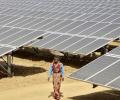
A top government official says that while India has made significant progress in renewable energy, technical issues are hindering large-scale implementation. The government is working on solutions such as grid flexibilisation and battery storage.

The government has mandated that cooking gas LPG supply to households will be discontinued if consumers fail to switch to piped natural gas where such connectivity is available, under a new order aimed at accelerating gas network expansion and reducing reliance on a single fuel.

Congress leader Rahul Gandhi has called on Prime Minister Narendra Modi to address the escalating conflict between the US, Israel, and Iran, particularly regarding the alleged assassination of the Iranian Supreme Leader. Gandhi emphasised the need for India to uphold international law and advocate for peaceful resolution.

'Moments like this remind us how fragile life really is.'

This threat comes as the assembly of experts in Iran has reportedly reached a majority consensus regarding the successor to the late Supreme Leader Ayatollah Ali Khamenei, according to the Tehran-based Mehr News Agency (MNA).

Prime Minister Narendra Modi addressed the BJP's 47th Foundation Day, highlighting the Uniform Civil Code and 'One Nation, One Election' as key unfinished agendas. He also reaffirmed the party's commitment to implementing women's reservation in the 2029 elections and criticised dynastic politics.

Trump has made it clear: the US will not lift its blockade of Iranian ports until a deal is signed.

'The US landed in this war without planning. The US felt that if they kill Ayatollah Khamenei the people of Iran will come out on the roads and do a regime change.' 'On the contrary, the US bombings on Iran has united the entire nation.'

Finance Minister Nirmala Sitharaman announces increased domestic LPG production to offset import disruptions caused by Middle East tensions, alongside assurances of fertiliser availability and the clearing of UPA-era oil bonds.

The brave displays of cricket's second-tier nations were the brightest feature of the Twenty20 World Cup, which got off to a rocky start and culminated in a predictable home win for white-ball behemoths India on Sunday.
